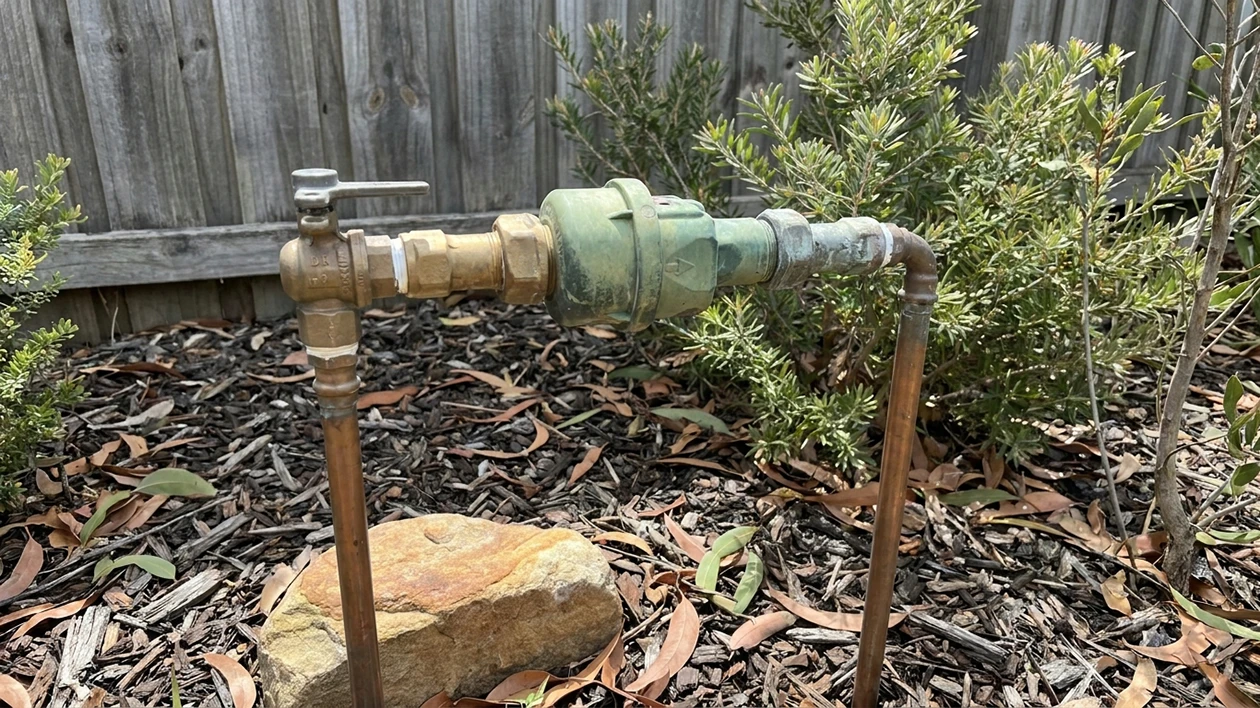
To turn off the water supply to your house, find the main stop tap next to your water meter, usually near the front boundary by the footpath. Turn a round handle clockwise until it stops, or turn a lever a quarter turn so it sits across the pipe.
If water is pouring through your ceiling or flooding a room right now, skip to the steps below. Read the rest once the water’s off.
Why every second counts: Water leaks are the second most common home insurance claim type at Budget Direct, making up 19% of its home claims over the past two years, at an average cost of $23,843. Flexi-hoses, found in bathrooms, kitchens and laundries in many Australian homes, are one of the leading causes. Newer homes aren’t immune either. In Budget Direct’s survey, 1 in 5 owners of homes built after 2000 had made a water damage claim, compared with 1 in 7 overall.
How to Find and Shut Off the Main Water Supply to Your House
In most Australian homes, the main stop tap sits right beside the water meter. For a freestanding house, that’s usually at the front of the property near the boundary, sometimes in a small in-ground meter box with a lid. Turn it clockwise to shut it off.
Your Valve Locator and Shut-Off Protocol
Step 1: Find the valve
Check these spots in order:
- Front garden or boundary: Look along the front fence line, near the footpath, in garden beds or beside the driveway. Many meters are hidden by plants or mulch.
- In-ground meter box: A small plastic or concrete lid set into the lawn or footpath. Lift it to find the meter and tap inside.
- Side of the house: Some older homes have the meter mounted against an external wall, close to where the pipe enters the house.
- Where the pipe enters the house: Some homes have a second stop tap here. It’s often easier to reach than the one at the meter.
- Units and apartments: Look in a meter cupboard in the hallway, the garage or a common area. Some units have their own isolation valve inside the laundry or kitchen. If you can’t find yours, contact your strata manager or building manager.
Do this today: Sydney Water asks property owners to keep at least 30 centimetres clear all around the meter. Trim back plants and rake away mulch. You don’t want to be digging for the tap while water pours through your ceiling.
Step 2: Work out which type of valve you have
- Ball valve (lever handle): A straight lever that sits in line with the pipe when the water is on.
- Gate valve (round handle): A round, wheel-style handle, common on older properties. Often called a stopcock or main tap.
- T-handle tap: A small T-shaped handle, common on meter taps. Turn it clockwise until it stops.
Step 3: Turn it off
- Ball valve: Turn the lever a quarter turn (90 degrees) so it sits across the pipe. Across the pipe means off.
- Gate valve: Turn the handle clockwise until it stops. Firm pressure only. Don’t force it past the stop.
Step 4: Relieve the pressure
Open the lowest tap in your house, such as the laundry tub or an outside garden tap. This drains the water still in your pipes. It also eases pressure on the leak. Water usually slows to a trickle within seconds and stops within a minute once the pipes drain.
Try this now: Go to your kitchen sink and turn on the cold tap. If the flow stops completely within about 30 seconds, you’ve shut off the main supply.
Common mistake to avoid: Using too much force on an old gate valve. Years of disuse can seize the internal parts. Crank on it hard and the spindle can snap. Then the water’s stuck on, or the leak gets worse.
Tip: Draining your pipes for a while? Switch off your electric or gas storage hot water system at the switchboard or gas control. Running a heating element in a tank that’s emptying can damage it.
How to Turn the Water Back On
Turn the main stop tap anticlockwise slowly, or move the lever back in line with the pipe. Open a cold tap to let the air out. Spluttering for a few seconds is normal. Check the repair for leaks, then switch your hot water system back on once water is flowing.
How to Shut Off Water to Just One Bathroom or Toilet
You don’t need to turn off the whole house to fix a single toilet or tap. Most fixtures have a small chrome isolation valve (sometimes called a cistern stop or mini stop) on the pipe behind the toilet or under the basin. Turn it clockwise until it stops.
Step-by-step:
- Look behind the toilet, low on the wall near the floor, or in the cupboard under the basin or kitchen sink.
- Find the small chrome valve on the flexible hose or copper pipe feeding the fixture.
- Turn the knob clockwise. Some valves have a flat slot instead of a knob, and you’ll need a flat-head screwdriver to turn the slot a quarter turn.
Other fixtures:
- Washing machine: Turn both taps on the wall behind the machine clockwise.
- Shower and bath: Most don’t have their own isolation valve, so you’ll need to turn off the main.
- Hot water system: Turn off the isolation valve on the cold water inlet pipe going into the tank. If your system is leaking, see our hot water system leaking guide.
Self-check: Flush the toilet. If the cistern doesn’t refill, the water to that toilet is off.
What to Do If Your Water Shut-Off Valve Won’t Turn Off
Start with a quick assessment. What is the valve actually doing?
| What you’re seeing | What it usually means |
|---|---|
| Handle won’t budge | Calcium and mineral build-up has seized the valve |
| Handle spins freely with no resistance | The spindle or internal mechanism has broken |
| Handle turns all the way but water keeps flowing | The internal washer or seal has worn out |
| Toilet keeps running even with the valve on | The cistern’s inlet valve or outlet seal is faulty, not the isolation valve |
| A regular tap won’t turn off fully | A worn washer or cartridge. Use the isolation valve under the sink, then book a leaking tap repair |
Troubleshooting action plan
- Don’t force it. Never use pliers, a wrench or a pipe extension on a stuck isolation valve or an old brass main tap. Breaking it under mains pressure can turn a small leak into a flood.
- Go to the main. If an isolation valve under a sink or behind a toilet won’t shut off, go straight to the main stop tap at the meter and follow the steps above.
- Relieve pressure. Open the bath or laundry tap to draw water away from the faulty valve while you work out your next move.
- Catch what you can. Put towels and a bucket under the leak and move anything valuable out of the way.
If the stuck valve is the tap at your water meter: In Sydney, the meter tap is part of your private pipework. Sydney Water does offer a free courtesy repair under certain conditions, but it can take up to 10 working days. That’s not a realistic option when the tap won’t close, it’s leaking, or you need the water off to stop a burst pipe. A licensed plumber is faster.
Next step: A valve that won’t turn, won’t seal or has snapped needs replacing, and that’s a job for a licensed plumber. In NSW, plumbing work like replacing valves must be carried out by a licensed plumber. If your main stop tap has failed and water is still running, call an emergency plumber.
What Happens When You Turn Off the Main Water Supply?
Turning off the main water supply stops new water entering your home. Your pipes, hot water system and toilet cisterns still hold some water until it’s used or drained. It’s completely safe. It’s also a smart move during a leak, before plumbing work, or when you’re going away for a while.
Am I allowed to turn off the water at the meter?
Yes. Sydney Water confirms the meter tap controls the water supply to your property and you can turn it on and off. It can look like a standard tap or a lever. You can’t connect a hose to it or use it to fill a bucket.
Sydney Water owns the meter and maintains it. Property owners are responsible for the pipes and fittings between the water main and the buildings or taps on their property. Turn the tap whenever you need to. Just leave the meter alone. If the meter is broken or damaged, call Sydney Water on 13 20 90.
Key takeaway: Can I still flush the toilet with the water off?
Yes, once. The cistern holds enough water for one more flush. After that, you can flush manually by tipping a bucket of water (around 20 litres) quickly into the bowl.
Shut-Off Valve Replacement and Upgrades: Costs and Options
Replacing a stuck or leaking shut-off valve is an inexpensive way to avoid a much bigger repair bill later. With Budget Direct’s average water damage claim sitting at $23,843, a new valve is cheap insurance. Professional replacement typically costs around $250 to $560, depending on the valve type and how easy it is to reach. Automatic leak-detection shut-off valves cost around $1,430 to $1,580 installed. They stop the water the moment they detect a leak.
| Option | Typical cost | Best for | Things to know |
|---|---|---|---|
| DIY replacement | Not permitted | N/A | In NSW, valve replacement must be done by a licensed plumber. Getting it wrong on a mains line can flood your home. |
| Professional replacement | $330 to $850 | Old, seized or leaking gate valves | Done properly, compliant, and covered by the plumber’s guarantee. |
| Automatic shut-off valve | $1,430 to $1,580 installed | Homeowners who travel often or want added protection | Detects leaks and shuts off the water automatically, often with alerts to your phone. |
Please note: The figures above are very rough estimates only and shouldn’t be treated as a quote. Every job is different, so contact Ready Set Plumb for a specific quote based on your needs. Call us on 0422 704 670 or get a free quote.
Best for budget: Swapping an old gate valve for a quarter-turn ball valve, installed by a licensed plumber. Ball valves are quicker to operate in an emergency. They’re also far less likely to seize.
Best for peace of mind: An automatic leak-detection shut-off valve, especially if you’re away from home regularly or have a holiday property. While you’re at it, ask your plumber to check the flexi-hoses under your sinks and behind your toilets, since they’re one of the most common causes of water damage claims. If you suspect a hidden leak, our leak detection service can find it before it causes damage.
Need a shut-off valve replaced or upgraded on the North Shore? Ready Set Plumb’s licensed plumbers can replace seized main stop taps and isolation valves, check and replace ageing flexi-hoses, and fit automatic shut-off systems. Call us on 0422 704 670 or get a free quote.