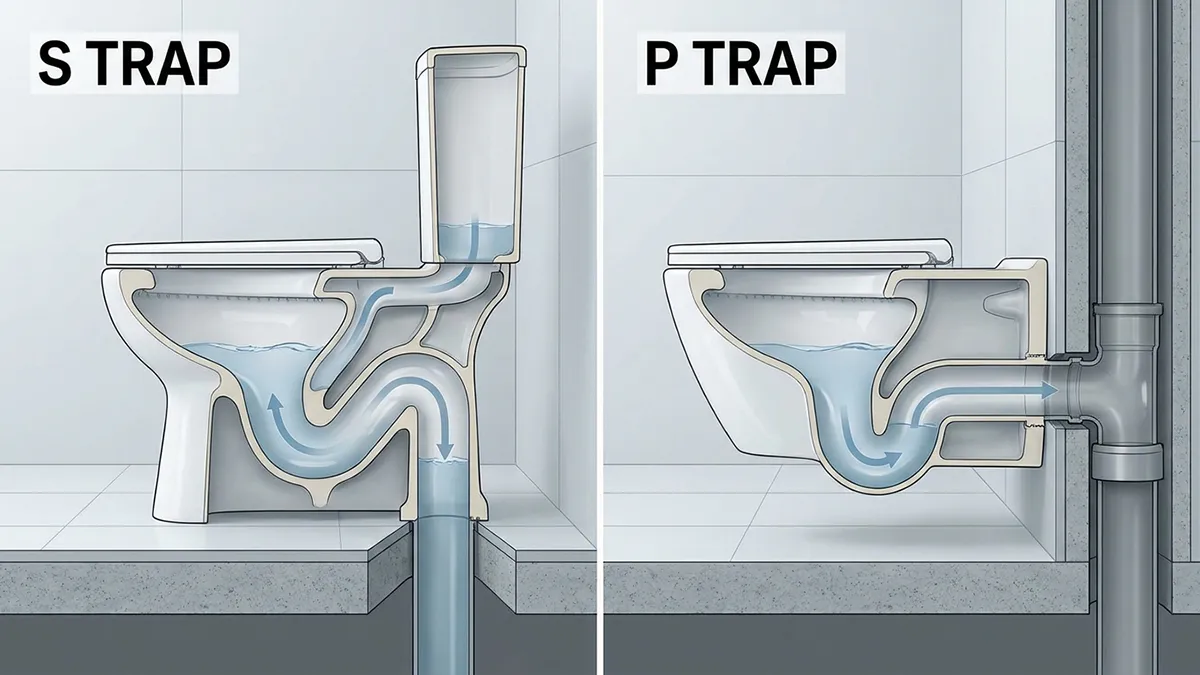
An S-trap is a toilet outlet that sends waste down through the floor. A P-trap sends waste out horizontally through the wall behind the pan. Both are legal in Australia. S-traps are the most common setup in Australian homes, especially older houses on concrete slabs. P-traps are standard in apartments and in bathrooms built for wall-hung toilets.
How Do I Know If My Toilet Is an S-Trap or P-Trap?
It’s a quick visual check. Look behind the base of the pan and find where the waste pipe goes. If it drops straight into the floor, you have an S-trap. If it runs back into the wall, you have a P-trap. Before you buy a replacement, you also need to measure the set-out in millimetres, because that number decides which toilets will fit.
The 60-Second Toilet Trap and Set-Out Audit
You’ll need: a rigid steel tape measure, a torch and your phone camera.
Step 1: Check which way the pipe goes
Kneel beside the toilet with the torch and follow the waste pipe from the back of the pan:
- It drops straight into the floor: you have an S-trap.
- It runs horizontally into the wall behind: you have a P-trap.
- It runs off to the left or right at an angle: you have a skew trap.
Step 2: Measure your set-out in millimetres
- S-trap: Measure horizontally from the finished rear wall (the tile face, not bare plaster or the skirting) to the centre of the floor waste pipe.
- P-trap: Measure vertically from the finished floor (the tile surface) to the centre of the wall waste pipe.
While you’re there, note where the water hose connects to the cistern. Suites are sold as bottom-inlet (the hose enters under the cistern) or back-inlet (the hose enters behind it), so match this too.
What Your Measurement Means
S-trap set-outs vary more than most people expect. There’s no single standard. Each toilet model accepts its own range, depending on the pan connector supplied, so treat the figures below as a guide and check the spec sheet of any suite you’re considering.
| Measured result | Trap type | What it means for replacement |
|---|---|---|
| About 140mm from wall to pipe centre | S-trap (typical for close-coupled suites) | Suits most close-coupled S-trap suites. Many accept roughly 90mm to 190mm with the connector supplied. |
| About 90mm from wall to pipe centre | S-trap (typical for back-to-wall pans) | A common set-out for back-to-wall toilets. Check the connector range on the spec sheet. |
| Over about 170mm from wall to pipe centre | S-trap (long set-out) | Often needs an optional long adjustable connector, usually sold separately. Confirm before you buy. |
| About 185mm from floor to pipe centre | P-trap | The standard outlet height for P-trap pans in Australia. |
| Pipe exits to the side | Skew trap | Needs a left-hand or right-hand skew pan to match the direction your pipe exits. |
My Back-to-Wall Toilet Hides the Pipe. Now What?
Back-to-wall pans cover the outlet completely, so try these checks:
- Look at the outside wall. Go outside behind the bathroom. A 100mm PVC pipe coming out of the wall at about toilet height likely means a P-trap. Keep in mind it could also be a waste pipe running down from an upstairs bathroom, or a vent pipe.
- Look underneath. In a raised timber house or a double-storey home, check the subfloor or the ceiling below for a pipe dropping vertically. That means an S-trap.
- Check your plans. Original building plans or your property’s sewer service diagram often show where the toilet waste sits.
- Concrete slab and nothing visible? Assume it’s an S-trap until a licensed plumber removes the pan and measures it.
Is Your Old Toilet Worth Replacing?
Usually, yes, if it’s a single flush toilet or a dual flush model from before 1995. To check, count the bolts at the base of the pan, because dual flush toilets installed before 1995 are usually held to the floor with four. Older single flush and early dual flush toilets can use up to 12 litres per flush. A modern 4-star water-rated (WELS) suite uses 4.5 litres for a full flush and 3 for a half. Swapping an 11-litre single flush toilet for a 4.5/3 litre dual flush saves about 11,000 litres of water per person each year.
Your Next Steps
- Save your trap type, measurement and inlet position in your phone notes (e.g. “S-trap, 140mm set-out, bottom inlet”).
- Take a clear side-on photo of the toilet base with the tape measure showing.
Are S-Traps Illegal in Australia?
No. S-traps are the most common toilet setup in Australia, and they’re completely legal. Most of the worry comes from American plumbing advice. US plumbing codes don’t allow S-traps under sinks, because a vertical drop straight after the bend can siphon the water seal dry and let sewer gas into the house.
Why S-Traps Got a Bad Reputation
How self-siphoning works. Every trap holds a small amount of water, called the water seal, which stops sewer gases like hydrogen sulphide coming back into your home. If a fast rush of water goes down a pipe that drops straight after the trap and nothing lets air in, the suction it creates can pull that seal out with it. That’s self-siphoning. Once the seal is gone, odours come back up the pipe.
Australian rules vs US rules. Many of the “S-traps are illegal” claims online come from North American codes. In Australia, plumbing must comply with the Plumbing Code of Australia (PCA) and AS/NZS 3500.2, the standard for sanitary plumbing and drainage. It doesn’t ban the S-trap shape outright. It sets rules for trap seal depth, venting, pipe length and grade so that every trap keeps its water seal. Toilet pans have the trap built into the porcelain and are designed to refill their seal after each flush, so S-trap toilets are fully compliant when a licensed plumber installs them.
Australian Compliance Cheat Sheet
- S-trap toilet (existing or new): ✅ Legal in Australia. Must be installed by a licensed plumber.
- Basin, sink or laundry trap (new or renovated): ⚠️ The layout must meet AS/NZS 3500.2 venting and pipework limits. Your plumber will choose a compliant arrangement, which may be an S-trap, a P-trap or an approved air admittance valve (a one-way valve that lets air into the pipe so the trap doesn’t siphon), depending on the site.
- Existing older under-sink S-trap: ⚠️ Generally fine if it works without odours or gurgling. Worth reviewing during a renovation, or sooner if problems start.
The 2-Minute Under-Sink Siphon Check
If you have an older S-trap under a vanity, kitchen sink or laundry tub, try this:
- Put the plug in and fill the basin halfway.
- Pull the plug and listen closely to the last few seconds of draining.
- Good result: It drains smoothly with no loud glugging, and there’s no rotten-egg smell within the next hour.
- Warning sign: Loud gurgling or recurring sewer smells suggest the trap is siphoning dry. Book a licensed plumber to assess the pipework and fix the venting or trap arrangement.
Which Trap Is Best for a Kitchen Sink?
Most new kitchen sinks in Australia are fitted with a P-trap running into the wall, because it holds its water seal reliably. An S-trap into the floor can still be compliant if the pipework meets AS/NZS 3500.2 limits. Your plumber will choose based on where the waste runs. If your sink is draining slowly rather than smelling, start with our guide to fixing a blocked kitchen sink.
When to Use an S-Trap vs P-Trap (And Is One Better?)
Choose an S-trap when you’re replacing a toilet on an existing floor waste. Choose a P-trap when the waste comes out of the wall, which is common in apartments and wall-hung installations. Neither one flushes better. Flush performance comes from the pan and cistern design, so your existing plumbing, your floor construction and the look you want are what should decide it.
Side-by-Side Comparison
| Criteria | S-Trap | P-Trap |
|---|---|---|
| Waste direction | Down into the floor | Back into the wall |
| Typical Australian property | Older detached houses, concrete slabs, raised timber floors | Apartments, townhouses, newer upper-level bathrooms |
| Compatible toilet styles | Close-coupled (cistern sits on the pan), link suites (cistern joined to the pan by a short pipe), back-to-wall pans (with converter) | Back-to-wall pans, wall-hung pans, concealed cisterns |
| Set-out flexibility | High, as adjustable connectors cover a wide range of set-outs | Lower, as the outlet height needs to match the pan (usually about 185mm) |
| Renovation impact | Moving a floor outlet on a slab means cutting concrete | Moving a wall outlet means opening the wall cavity |
Best For
Straight swaps on concrete slabs: S-trap (or a universal suite)
Sticking with your existing floor outlet means no slab cutting, no excavation and no waterproofing repairs. It’s the cheapest path.
Apartments and full renovations: P-trap
You’ll need one where the waste already comes out of the wall. It’s also the way to go if you want a wall-hung pan with a clear floor underneath for easy cleaning.
Maximum flexibility: a universal back-to-wall toilet
Many back-to-wall pans sold in Australia are built as P-traps and come with an S-trap connector in the box, so the same toilet fits either setup.
Decision Guide: Which Trap Do You Need?
Is it for a sink or basin?
- A licensed plumber designs a compliant trap and vent layout under AS/NZS 3500.2.
Is it for a toilet, and are you keeping the existing waste pipe?
- Pipe exits the floor: choose an S-trap that matches your set-out.
- Pipe exits the wall: choose a P-trap and confirm the outlet height (usually about 185mm).
Is it for a toilet in a full bathroom renovation?
- Concrete slab on the ground floor: stay with an S-trap unless your budget allows for slab cutting.
- Timber floor or stud wall: a P-trap is viable and suits wall-hung pans and concealed cisterns.
Can You Replace an S-Trap With a P-Trap? Australian Conversion Rules and Costs
Yes, but it isn’t a simple swap. Going from an S-trap to a P-trap means moving the waste connection from the floor into the wall. That involves relocating drainage pipework, opening up the wall and often cutting into the slab or floor. In every Australian state and territory, this is regulated plumbing work and must be done by a licensed plumber.
Can I Do It Myself?
Generally, no. Homeowners in Australia can do only minor jobs, such as changing a tap washer or a shower head. The exact list varies by state. Removing or installing a toilet, altering waste pipes or moving drainage is regulated sanitary plumbing, and that holds everywhere in Australia. Unlicensed work can void your home insurance and create problems when you sell. It can also mean paying a plumber to redo the job.
Converter bends are a grey area for DIYers. Hardware stores do sell S-to-P and P-to-S converter bends, and they’re legitimate products. They still need to be fitted by a licensed plumber so the connection is sealed, supported and compliant.
Once the work is done, your plumber should give you a Certificate of Compliance, which confirms the work meets the Plumbing Code of Australia. Keep it with your property records.
What Does It Cost? (Indicative Ranges)
A like-for-like toilet swap typically costs $300 to $1,000 installed. Converting an S-trap to a P-trap costs far more, because it means moving drainage through the floor and wall.
| Job | What’s involved | Indicative cost |
|---|---|---|
| Like-for-like toilet swap | Remove the old suite and install a new one on the same outlet | About $300 to $400 for a basic swap, and $600 to $1,000 for a typical install |
| Swap with converter or long connector | New suite plus an adjustable connector or converter bend | Similar to a standard install, plus parts |
| S-trap to P-trap on a timber floor | Reroute the waste through the subfloor and wall, patch and re-tile | Quoted on site |
| S-trap to P-trap on a concrete slab | Cut and excavate the slab, relocate the drain, re-pour, waterproof and re-tile | The most expensive option, often part of a full bathroom renovation |
Prices vary with location, access, tiling and how much of the bathroom is disturbed. Always get a written quote.
Replacing a Toilet on Sydney’s North Shore?
Ready Set Plumb replaces S-trap, P-trap and skew-trap toilets across Roseville and the North Shore. We’ll measure your set-out, confirm the suite fits before you buy and issue a Certificate of Compliance when the job’s done. Send us the details below for a quote.
Plumber Quote Checklist
Send this information when you ask for a quote. It helps the plumber give you an accurate price without a site visit:
- Trap type: S-trap / P-trap / skew trap
- Set-out measurement: ___ mm (wall to pipe centre, or floor to pipe centre)
- Water inlet: bottom inlet (hose enters under the cistern) / back inlet (hose enters behind the cistern)
- Floor type: concrete slab / raised timber / upper level
- Job type: like-for-like swap / converting S to P / full renovation
- New suite: brand, model and a link to the spec sheet
- Photos: side-on photo of the toilet base with the tape measure showing, plus a wide shot of the bathroom
- Known issues: odours, slow flushing, leaks around the base, cracked tiles
Questions to ask your plumber:
- Is my set-out within the range of the suite I’ve chosen?
- Will I need a converter, a long connector or any pipework changes?
- Does the quote include removing and disposing of the old toilet?
- Will you provide a Certificate of Compliance for the work?
- What happens to the price if you find damaged pipework once the pan is off?
Before You Buy
Measure first. Work out whether your waste goes into the floor or the wall, write down the exact millimetre set-out and check it against the spec sheet of any toilet you’re considering. S-traps are completely legal in Australia, and in most homes, keeping the existing outlet is the quickest and cheapest option. Moving from an S-trap to a P-trap is worth it mainly during a full renovation, especially if you want a wall-hung toilet. If you’d rather have it measured and fitted properly, book a toilet replacement with Ready Set Plumb.